From 28-29 May 2026, the inaugural African Space Law and Policy Conference was held in Pretoria, South Africa, with the theme “Laying Firm Foundations for the Sustainable Development of Africa’s Space Economy.” The Conference was organised by the University Of Pretoria, Faculty of Law; McGill Institute of Air and Space Law, Canada; South Africa’s Department of International Relations and Cooperation (DIRCO), the dti (Department of Trade and Industry: Republic of South Africa) and the South African National Space Agency (SANSA).
In its conference note, the organisers stated that “as more African States develop national space programmes and engage in regional initiatives under the auspices of the African Space Agency the need for coherent legal and policy frameworks is becoming increasingly evident.” Furthermore, “the harmonious interpretation and application of international space law and Africa’s legal frameworks governing continental space activities enhance regulatory efficacy and strengthen the competitiveness of the African space sector.” Hence, the theme of the conference was timely and apt. It deliberated on the current context of space law and governance; national and regional developments in space law and policy; commercial space activities; space security and military use of space; as well as Africa’s role in global space governance. It also provided an opportunity to discuss the African Space Policy and Strategy, which gives guidance on Africa’s space policies, positions, programmes and partnerships.
Outer Space became an area of interest to the African Union (AU) in 2000, as it was a component of the formalisation of partnership between the African Union (AU) and European Union (EU). By 2010, it became an Agenda item of the AU Summit. During the 15th AU Summit in July 2010, there were three space-related items on the Agenda, namely:
- a report from Algeria concerning the 3rd African Leadership Conference on Space Science and Technology for Sustainable Development (ALC), which was held in Algiers in December 2009 and a report on a satellite constellation initiative called African Resources Monitoring Satellite Constellation (ARMC);
- South Africa’s request for support in its bid to host the Square Kilometre Array (SKA); and
- progress report on the establishment of the Pan-African University (PAU) and consequent request for Southern Africa to nominate a country to host the Pan-African University Institute for Space Sciences (PAUSS).
(The ALC has not taken place since the 8th edition that was held in Addis Ababa, Ethiopia; South Africa eventually won a major part of the hosting of the SKA; the Pan-African University Institute for Space Science is yet to commence.)
In 2012, the African Union (AU) established the African Union Space Working Group (AUSWG) with five Terms of Reference, including the drafting of four documents: continental space policy, strategy, implementation plan and governance framework. After a series of working group sessions, validation workshops, consultations with professional groups and ministerial conferences, the AUSWG produced two documents – a space policy and a space strategy – serving as the first set of documents towards the formalisation of the African outer space programme. The African Outer Space Programme is one of the flagship projects of AU’s Agenda 2063.

After passing through the decision-making process of the AU, the African Space Policy and Strategy were adopted by African Heads of State and Government in January 2016. The Heads of State and Government further requested the AUSWG to “develop the framework for the implementation of the African Space Policy and Strategy and the Governance Framework that covers the relevant legal requirements and protocols for an operational African Outer-Space Programme.” [Assembly/AU/Dec.589(XXVI)]
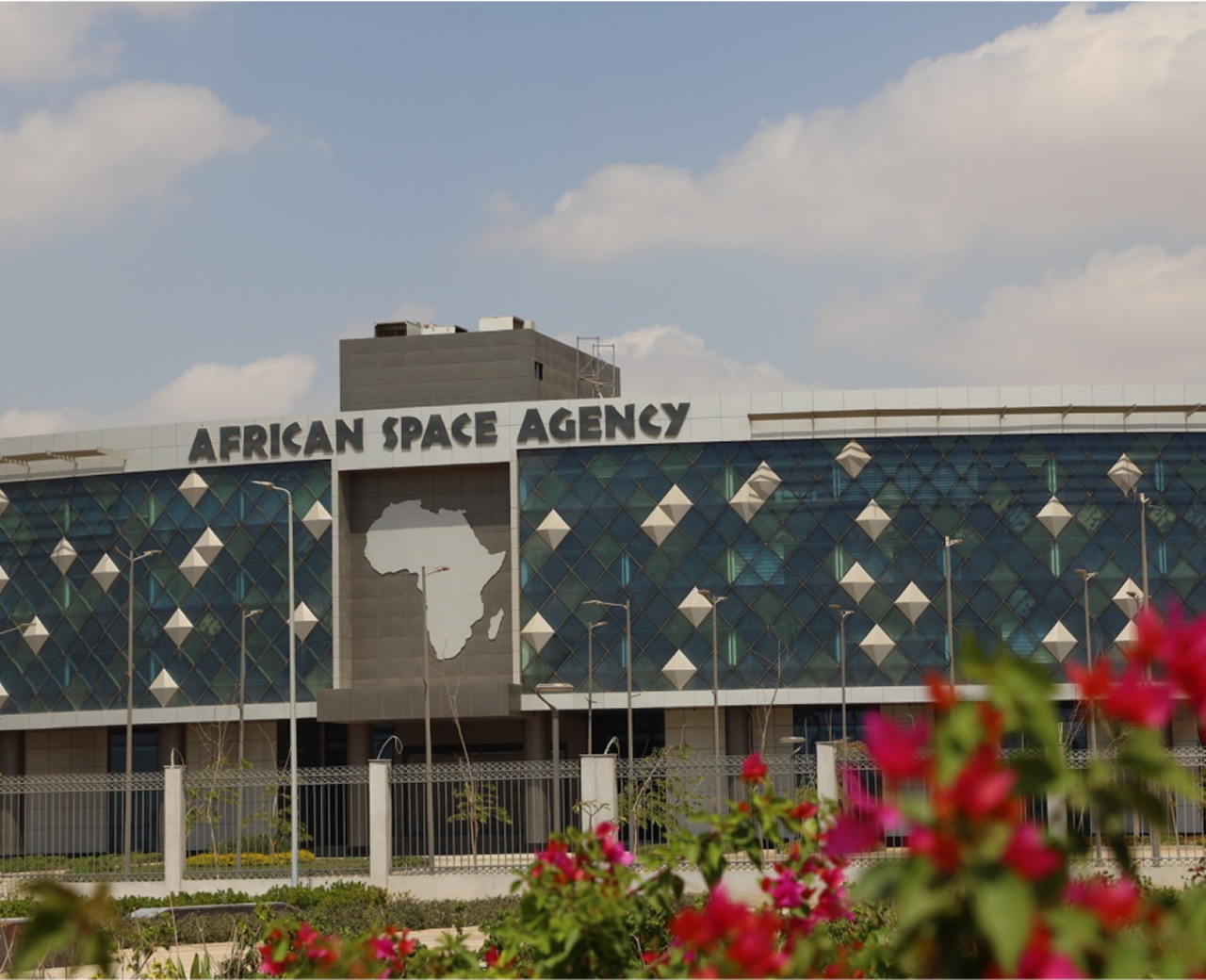
To implement the continental space policy and strategy, the AU established the African Space Agency (AfSA) through the adoption of its statutes in 2018, and chose Cairo, Egypt, to host its headquarters. The secretariat building was inaugurated in April 2025 and the African Space Council has been constituted.


The Statute of the African Space Agency (AfSA) is a legally binding document, with several provisions and requirements including:
- a management and governance structure for AfSA which shall consist of four bodies, namely the African Space Council, advisory committee, secretariat and a Director General. The statute does not allow for anything more or short of this [Article 6.1]
- the African Space Council shall comprise 16 members – 10 elected from each of the geographical sub-regions of Africa and 6 representatives from the African Union Commission [Article 7.1]. The elected members alone does not constitute the Council; the representatives of the African Union Commission (AUC) have to participate in the sittings and other activities of the Council.
- though the AUC representatives are valid members of the Council, they have no voting rights [Article 7.3]. However, this does not stop them from participating in the activities of the Council; they are only excluded from decision-making that require voting.
- the Council’s sole role is to exercise oversight functions over AfSA, not to perform executive functions [Article 10.1]
- the Council should meet only after the meeting of the Advisory Council [Article 10.3]. The composition of the Advisory council is listed in Article 12.2.
- the Director General (DG) shall be the Chief Executive Officer (CEO) and legal representative of the Agency [Article 15.1]
- the DG shall be responsible for the day-to-day operations of the Agency [Article 15.2]. In other words, the DG, working with the secretariat, has executive functions.
- the DG serves as Secretary of the African Space Council [Article 7.5] as well as Secretary of the Advisory Council [Article 12.3]
There are some parts of the Statute which appear to be in conflict or are no more valid. For example:
- following recent AU institutional reforms, the offices listed in Article 7.1(b) are no longer existing. This means that the section should either be expunged from the statute or be revised to accommodate the appropriate offices.
- Article 9.3 suggests that the President and Vice-President of the African Space Council shall function on a full-time basis. Their roles at the Agency’s secretariat vis-a-vis that of the Director-General in the same secretariat, are not clear.
- It’s not clear whether the other members of the Council who operate on a part-time basis will be paid just as the President and Vice-President of the Council.
Perhaps, more foundational is the institutionalisation of AfSA as an ‘organ’ of the AUC (Article 2 of the Statute), when other bodies of the AU functioning in similar domains (such as the African Civil Aviation Commission) are structured as ‘specialised agency’. Compared with a similar continental space agency, the European Space Agency (ESA) does not function as an ‘organ’ of the EU. Similarly, the International Telecommunication Union (ITU) functions as a specialised agency of the United Nations (UN).
Still on governance, following the AU reforms, a Division of Science, Technology and Space (STS) was established within the AUC. This Division’s roles need to be explicitly stated in order to avoid friction with the African Space Agency and Council.
Regarding programmes, the Space Agency and its Council are still guided by the African Space Policy and Strategy. These policy and strategy documents contain Key Performance Indicators (KPIs) which were adopted for assessing the state of the African outer space programme. These KPIs include, but not limited to:
- Number of communities of practice
- Returns on investment.
- Number of services and products using African capacities.
- Number of publications, patents and industrial designs
- Number of space-related research Centres.
- Number of graduates in space-related fields
- Number of space-related experts employed in space-related professions
- Number of contributions made in multilateral forums crucial for the peaceful uses of outer space
- Number of orbital slots obtained for Africa
- Number of early warning systems on the continent
- Number of space missions
- Number of space receiving/transmitting/processing facilities
- Number of networks created and percentage of coverage.
- Number of collaborative intra-continental programmes
- Number of partnerships: public-private, intra-Africa and international partnerships
- Level of long-term funding secured from the continent and Financial mechanism for the raising of funds developed
Also, there are strategic actions, interventions and goals listed in the African space strategy, as well as projected outcomes at the end of first, fifth and tenth years.
On the global scene, new technologies and issues have emerged including megaconstellations, lunar exploration, re-entry of space debris, sovereign launch capabilities, spaceports, exploitation of space resources, cybersecurity of space systems, space weaponisation, orbital congestion, Rendezvous and Proximity Operations (RPO), nuclear power sources, Space Domain Awareness (SDA) and norms development. What is the mechanism for common African positions and actions on these developments?
As this year marks the tenth anniversary of the adoption of the African Space Policy and Strategy, it is a suitable time to review the space policy and strategy documents, the statutes of the implementing agency and the African continental space programme.