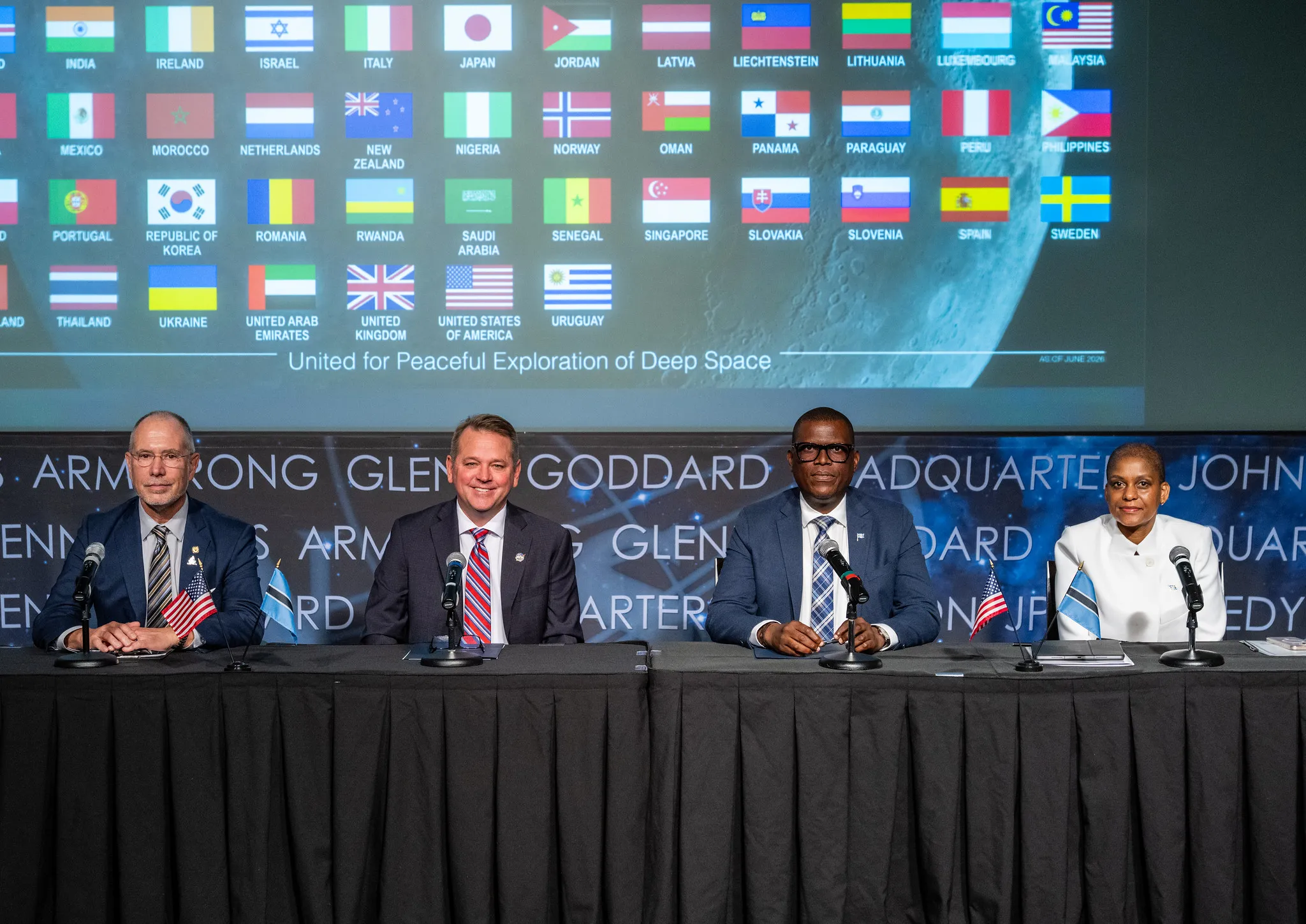

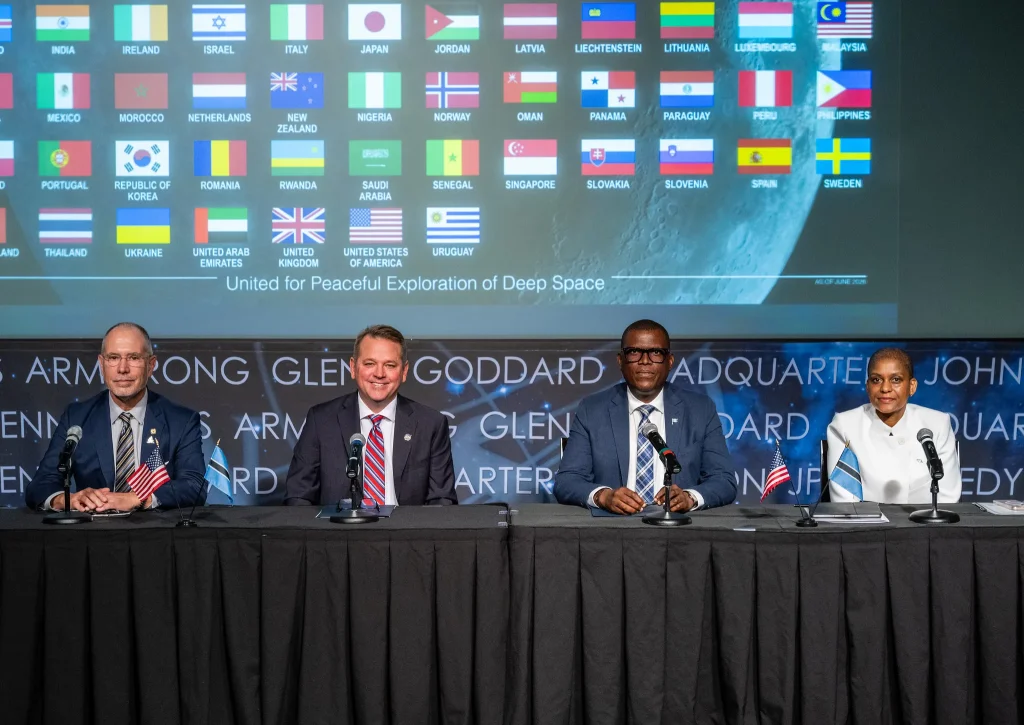
Minister of Communications and Innovation David Tshere (second from right) at the Artemis Accords signing ceremony, NASA Headquarters, Washington, D.C., 25 June 2026. Credit: NASA / Keegan Barber
On 25 June 2026, Botswana’s Minister of Communication and Innovation, Hon. David Tshere, signed the Artemis Accords at NASA Headquarters in Washington, D.C., making Botswana the 68th nation, and sixth African country, to join the Accords. The optics were tidy and diplomatic: handshakes, flags, the usual choreography of a milestone. However, strip away the ceremony and the hard questions emerge: what does the accession actually mean in trade and industrial terms? Why is Botswana still struggling to convert trade access into industrial depth? What is Botswana’s domestic and strategic stake in the partnerships it is forging?
A Signature Built on a Larger Story
Nigeria and Rwanda were the first set of African countries to sign the Artemis Accords during the inaugural U.S.-Africa Space Forum which was held in December 2022. Angola followed in November 2023, then Senegal in July 2025, Morocco in April 2026 and Botswana in June 2026. Space is no longer a niche interest for a handful of countries; it has become a frontier for African countries to position themselves diplomatically and economically, often ahead of their industrial readiness to absorb what that positioning could deliver.
Botswana’s entry into the Artemis framework builds on an existing relationship with the United States (U.S.) in space-based earth observation, a relationship that stretches back to the early 1970s, through Botswana’s participation in the U.S. Landsat programme. The relationship matured in March 2025, when BOTSAT-1, the Botswana’s first earth observation satellite, was launched from SpaceX’s Falcon 9 rocket.
BOTSAT-1 was built by EnduroSat, a Bulgarian manufacturer and it contained a hyperspectral payload built by South Africa’s Dragonfly Aerospace. While Botswana did not design nor manufacture the satellite, about eighty engineers from the Botswana International University of Science and Technology (BIUST) participated in the Assembly, Integration and Testing (AIT) processes, conducted in Sofia, Bulgaria, and BIUST now runs its own ground station in Palapye, Botswana. It is intended that the successor, BOTSAT-2, will build on the knowledge and skills gained.
Shortly after Botswana, Mauritius signed the Artemis Accords in July 2026, ahead of the forthcoming U.S.-Africa Business Summit, scheduled to be held in December 2026, in Mauritius. Mauritius’ accession brings the number of Artemis Accords signatories to 70. It again raises the question: which countries convert this framework into industrial outcomes, beyond signatures? A view, using the African Continental Free Trade Area (AfCFTA) lens, would be useful.
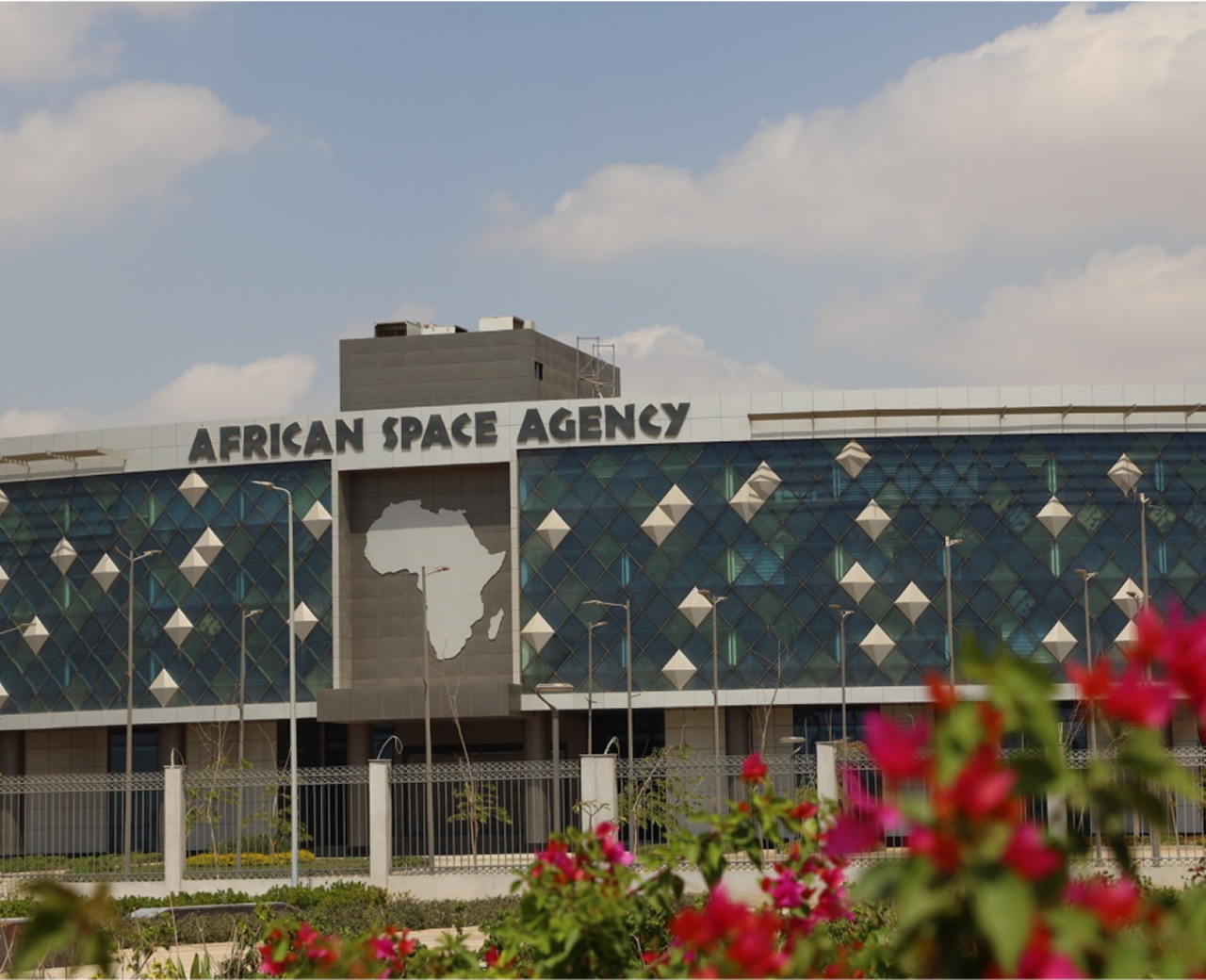
AfCFTA is one of the flagship projects of the African Union (AU), just as the African Outer Space Programme been implemented by the African Space Agency (AfSA). In force since 2019, and with its secretariat in Accra, Ghana, the AfCFTA is the world’s largest free trade area, creating a single continental market for goods and services across the AU’s 55 member states. Its aim is promote intra-African trade and industrialisation, by dismantling tariff and non-tariff barriers between African economies. In the AfCFTA framework, Earth observation and satellite data are regarded as tradable services. The Protocol on Trade in Services gives Botswana a regional framework through which BIUST-processed data-products could be exported to other African countries, not only consumed locally. This will require data standards, rules of origin for digital services, and licensing regimes, which do not exist yet. The Artemis Accords do not set out this groundwork; they simply make the market access worth building for.
The Absorptive Capacity Problem
Accession to a framework like the Artemis Accords does not generate trade or industrial value on its own. It opens a door into supply chains around satellite components, ground infrastructure, data services and downstream applications in agriculture, mining and climate monitoring – sectors that Botswana already targets. Whether that door leads anywhere depends on what economists call absorptive capacity: the extent to which a country’s institutions, skills base and firms can take in and use new technology and capital.
My research on AfCFTA and industrialisation, including a 2024 co-authored study on AfCFTA’s prospects for industrialisation and economic diversification points to a broader challenge as market access alone does not automatically translate into industrial gains. Low trade diversification and thin regional manufacturing networks remain significant constraints on the ability of African economies to convert expanded market opportunities into productive capacity, jobs, and export growth. This suggests that the effectiveness of economic integration depends not only on reducing barriers to trade, but also on strengthening the domestic and regional capacities needed to absorb investment, build local firms, develop productive linkages, and compete in higher-value markets. The same logic applies here, with higher stakes: a satellite launch or an Accords signature can generate headlines, but jobs, local firms and exportable services depend on absorptive capacity.
Space Diplomacy as Industrial Strategy
The Artemis Accords sit within a wider contest over the rules, technology and economic architecture that will govern human activity in outer space for the rest of this century, a contest that increasingly involves trade negotiators and development banks, alongside space agencies. For a small, capital-constrained economy like Botswana, signing is a way of securing a seat at the table, and a relationship, before the rules are fully written. There is no guaranteed outcome. The mental model is that it is better to be at the table shaping the framework than outside it, accepting terms set by others.
It is also worth noting that the Artemis framework is not the only architecture on offer. A smaller group of countries, including South Africa, Egypt and Ethiopia, have signed the International Lunar Research Station (ILRS) Partnership and joined the International Lunar Research Station Cooperation Organization (ILRSCO), led by China and Russia. Senegal however has signed both the Artemis Accords and the ILRS agreement. (The different African positions need a more critical analysis.) Botswana’s choice of the Artemis path is therefore not a neutral technical decision; it is a diplomatic one, aligning the country’s future space and data infrastructure with a particular bloc of partners, standards and, eventually, supply chains.
States with reservations about the Artemis Accords have generally worried that a U.S.-authored framework encodes U.S. priorities on space resource extraction and lunar activity to which acceding states did not contribute. This is not a reason to avoid or decline signing. It is a reason to be precise about what is intended to be secured, and to resist letting the accession itself substitute for the needed policy work.
What next?
The Artemis Accords is a set of non-binding political commitments; it is not a treaty and is not enforceable space law. This distinction raises another question: should a comprehensive national space policy have been drafted before the Artemis accession? Letting a foreign-authored accession framework function as a de facto placeholder for domestic policy carries its own risk, since non-binding commitments can be revised or reinterpreted by the countries that wrote them, with little recourse to ‘smaller’ signatories.
None of this is an argument against ambition. BOTSAT-1 already demonstrates that Botswana can execute complex, internationally partnered space projects competently, and that BIUST’s engineers can hold their own on a demanding technical programme. The Artemis Accords provide a governance framework and a set of relationships that can, if managed well, translate into technology transfer, training pipelines and market access for nascent space economies. Botswana needs to move beyond the excitement of the moment, and begin the institutional work needed to convert the opportunity into industrial reality.
The institutional work has a fairly short list of priorities: a trade policy; national space policy aligned to the trade policy; dedicated space agency to replace BIUST’s pro tempore role; strategy for capacity building and workforce development; and a procurement framework that gives priority to Botswana firms, including in the development of BOTSAT-2 and subsequent projects.
Botswana needs to convert the current momentum into domestic capacity. That is the real lesson of 25 June 2026. The Accords cannot do these for Botswana, nor for any of the signatories.
About the author
 Sesha Nyanga is an independent Trade Governance and Regional Integration Consultant based in Gaborone, Botswana, and an ASLI Policy Fellow working at the intersection of AfCFTA policy and African space governance.