Space is usually presented through its most visible achievements: satellites launched, missions completed, astronauts in orbit and new technologies developed. Yet the work of the UNITY Charity Foundation demonstrates another dimension of the space sector, one that begins not with a spacecraft, but with children.
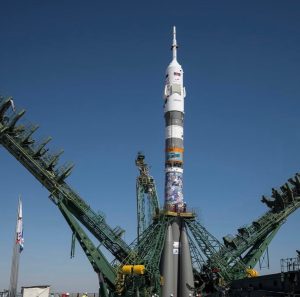
Since 2016, UNITY has developed international programmes that combine psychosocial support, education, art, medicine and international cooperation. One of the Foundation’s most distinctive initiatives is Space Art Therapy – an international programme for children with cancer, that uses art and space exploration as tools for emotional support, inspiration and connection with the wider world. Its flagship Art Rocket Project has brought together children from 18 countries. In 2025 and 2026, children’s drawings were transformed into large-scale artworks on two Soyuz launch vehicles and sent into space from the Baikonur Cosmodrome.
Soyuz MS-29, Art Rocket II (14/07/2026) Credit: Roscosmos
This approach to international space cooperation matters because it changes the relationship between people and space. It introduces a new angle of diplomacy in healthcare and space that is able to bring countries, institutions and communities together around a shared human experience, rather than around strategic or technological interests alone. A child receiving cancer treatment is not simply an observer of space exploration. Through the programme, that child becomes part of a space mission.
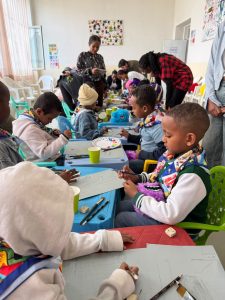
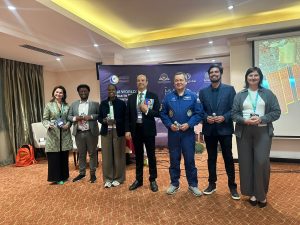
The most recent expression of this work took place in Addis Ababa, Ethiopia. Following the World Public Summit Africa, UNITY conducted its Space Art Therapy programme at Tikur Anbessa Specialized Hospital, in cooperation with the Tesfa Addis Parents and Childhood Cancer Organization. Children undergoing treatment participated alongside Cosmonaut Oleg Skripochka; Raksana Batsmanova (a former NASA nurse and Specialist in Medical Support for Space Missions); and ASLI Education Programme Associate, Kubakurungi Saphirah; among other international representatives.
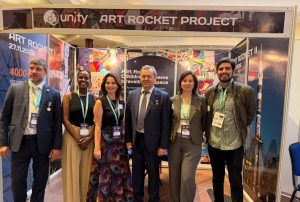
Discussants at a roundtable with the theme “Space Without Borders: Uniting the World Through Education, Science and Humanitarian Partnerships,” held during the mission
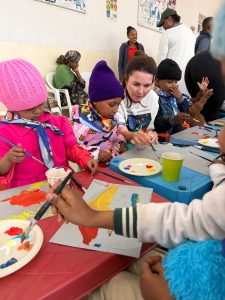
For some of the children, human spaceflight was an unfamiliar concept. By the end of the mission, their drawings featured rockets, planets, cosmonauts and aircraft. Their artwork was not simply produced as a therapeutic exercise and left behind. UNITY’s model creates the possibility for these children’s dreams to become part of an actual space mission, which will now be featured in the forthcoming Art Rocket 3 Project.


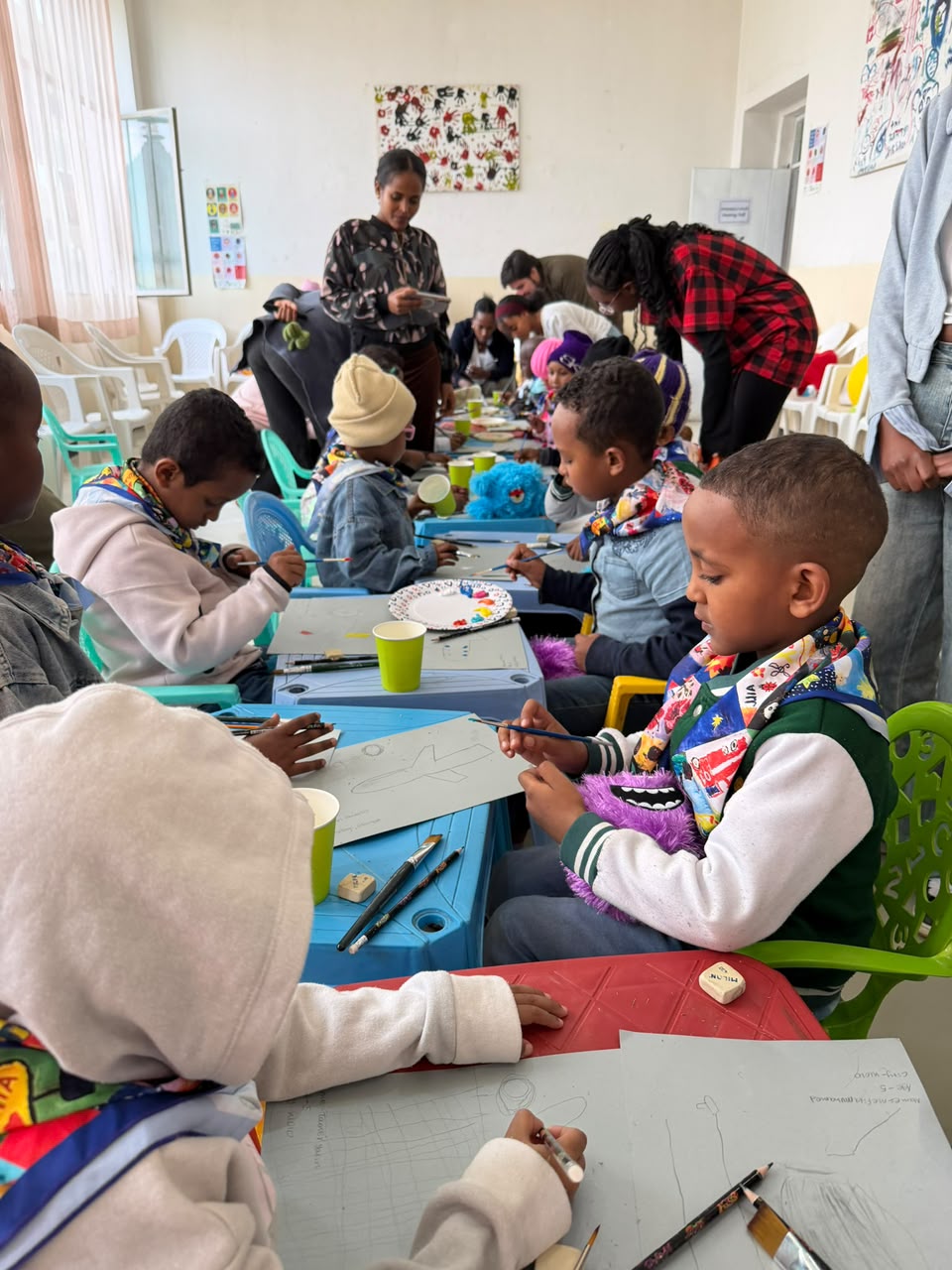
Space Art Therapy Session with children from the Tesfa Addis Parents and Childhood Cancer Organisation
This is what makes the initiative significant. The programme does not attempt to make cancer disappear through space technology. Instead, it addresses the emotional and psychological experience of children living through serious illness. The intervention gives them an opportunity to imagine beyond the immediate reality of treatment.
The experience in Addis Ababa shows how space-related initiatives can intersect with existing social challenges without pretending that space is a substitute for healthcare or humanitarian services. A hospital remains a hospital; cancer treatment remains the priority. What the space sector can contribute is an additional layer of education, inspiration, psychosocial support and connection.
At the World Public Summit at the United Nations Economic Commission for Africa (UNECA) headquarters, Addis Ababa, Ethiopia

The strongest lesson from UNITY’s work is not that space can solve every humanitarian problem. It cannot. The lesson is that the space sector has an opportunity to engage with people in ways that go beyond the delivery of technical services. For a child undergoing cancer treatment, seeing a drawing travel into space can provide something that a satellite or launch vehicle cannot be measured to provide: a sense of participation in something larger than the circumstances immediately surrounding them.
Africa’s space programmes are developing rapidly, but the benefits of the sector are still largely discussed through national infrastructure, scientific capability, economic opportunity and technological development.Those priorities are necessary. They are not, however, the entire picture.
For ASLI, the engagement provides an important opportunity to examine a dimension of space leadership that is sometimes overlooked. ASLI works to strengthen African space policy and decision-making through policy analysis, education and expert advisory. The Institute’s engagement with UNITY brings that leadership conversation into contact with a very different setting: the hospital, the child and the family.
Saphirah Kubakurungi is a lawyer with over five years of experience contributing to the growth of the space sector in Africa and beyond. Her work spans from space law, policy to governance and education. She is strongly committed to institutional-building, knowledge-sharing and the development of emerging space ecosystems. She has also been actively involved in shaping Uganda’s emerging space sector. In 2024 she was appointed to a highly specialised task-force, by the Ugandan Aerospace Bureau, to help with drafting Uganda’s space legal and policy framework. In 2023, she became the first Ugandan to attend the International Space University (ISU) and take part in its Space Studies Program. She later returned in 2025 as a Teaching Associate. Alongside these efforts, Saphirah is an active member of various international organisations including the International Institute of Space Law (IISL) and the Space Generational Advisory Council (SGAC). She serves as Programme Associate for ASLI Education.